Appreciating Abstract Art May 11 2026, 0 Comments
By Kimberly Nicoletti
Abstract art often carries unfounded stigmas, causing some people to dismiss the amazing experiences it can open up.
Ironically, each extreme of stigma lands on opposite ends of the spectrum. On one hand, some people reduce abstract art to lazy, easily-produced paintings that just about anyone could do. Others regard it as so highly intellectual or so complex that they don’t even take time to consider it.
Which is a shame.
When co-owner Brian Raitman says that much of the best art ever created is abstract, he’s certainly not high-browing it. He simply means that quality art — particularly abstract — offers us new ways of seeing, or understanding, beauty.

"Out of the Blue" by Pat McNabb Martin
While realistic landscapes automatically transport us into serene regions we might not otherwise experience, abstractions of nature can jolt us out of our typical way of perceiving a landscape and draw us deeper into the wonders of our natural environment. In other words, abstract art provides fresh perspectives.
For instance, Kristof Kosmowski’s more cubic representation of water lilies or his blurred golden aspen leaves reflecting in a pond emphasize color and texture, as opposed to subject matter. His lens is akin to an out-of-focus photo, which features color first, shapes and texture second and, finally, meaning.
Through his technique, he tricks our brains into thinking differently.
Typically, our minds immediately place labels and meaning on what we see; it’s an evolutionary survival skill: We needed our brains to instantaneously recognize poisonous red baneberries, with their feathery, saw-toothed, fuzzy-underside leaves. So now, we see a plant and automatically label it safe or poisonous, appealing (“pretty”) or nonappealing (“dangerous”).
We often bypass the joy of taking in just how glorious a flowering plant is by naming it a “rose,” “marigold,” etc. Even if we do register its majesty for a moment, our brains thrive on efficiency, causing us to stop and smell the rose with half of our attention, while our thoughts rush on to the next thing, because we’ve “been there, done that.”

Abstract art like Kosmowski’s interrupts our “been there, done that” pattern by emphasizing color, shape and texture, rather than delivering an immediately recognizable element like a water lily. You wouldn’t know his “Pond” painting reflects golden aspens if he didn’t name it “Pond.” His approach entices us to linger and enter into a fuller relationship with the piece, rather than automatically registering “pond in autumn” and moving on.
Abstract art presents a puzzle, or mystery, that our brain feels compelled to “solve,” because we’re typically uncomfortable with the unfamiliar.
It’s this power of abstract art to stimulate the mind and spur the imagination that has made it so popular since it first emerged in the early 20th century. The freedom of expression it allows the artist to explore results in viewers’ freedom to interpret as they see fit.
At its purest, abstract art invites viewers to discover their own “images” within a work, and, ultimately, their own meaning.
As humans, we have a nearly uncontrollable urge to find meaning, or at least put things into context. Abstract art gives us a framework — literally — to search for that meaning, without confining us to an exact “right answer.” That’s authentic freedom: the power to think independently, without restraint.
As Brian points out: It gives us the opportunity to discover what we like.
Probably the most popular form of abstract art is abstract expressionism. The form started in New York in the 1940s and 1950s with a priority on spontaneously expressing emotions. Think: Jackson Pollock’s drip techniques or Willem de Kooning’s energetic brushstrokes that generate a sense of motion.
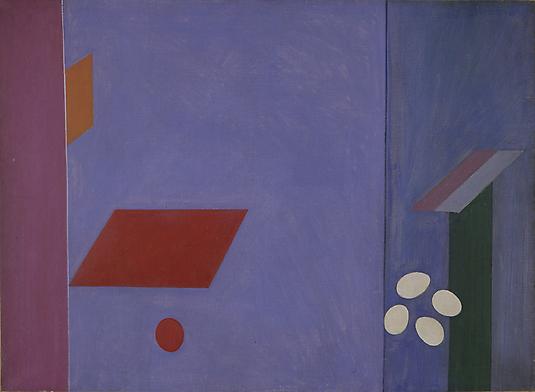
Untitled Abstraction by Willem de Kooning c. 1931
“They’re expressing something. We don’t always necessarily know what it is, but it is communicating on an instinctual level that we all possess. There is joy and true beauty in the mystery.” Brian says.
You don’t have to be able to identify even one of the 300 different species of wood Christopher Cantwell integrates into his 3D wood sculptures to marvel at his innovative work.
You don’t need to know that Anna Elise Johnson contemplates how societal systems, including movies, determine how we view the world to feel the wavelike reflections in her paintings such as “Missing Waves” or “Diversion.” Her “Solaris Waves” and “Diversion” paintings aren’t any less powerful because you don’t know that she stopped the 1972 sci-fi movie “Solaris” on her computer at a particularly compelling moment, took a screenshot, and based the large color fields she placed over her original oil paintings on that exact moment in the film. You don’t have to know that the shapes in “Missing Waves” stem from the 1974 movie “Chinatown,” about a massive conspiracy involving water theft in Los Angeles. You just know when an abstract piece speaks to you.
“The paintings become really abstract, but then they’re also weirdly specific because they are from something — like a shape that seems notable or memorable to me in a way,” Anna Elise Johnson says. “(The shape) has a feeling that I’m after.”
Sure, knowing more about an artist’s process may deepen your understanding or appreciation of a piece. But ultimately, as Brian points out: “Abstract art gives us a window into our own minds. It’s kind of a study of: What do I really like? Because I’m not looking at anything, per se.”

"Missing Waves" by Anna Elise Johnson
And, as Anna Elise Johnson simply states:
“It’s cool when an artist can do something that just feels fresh and new without doing anything representational. … It’s a questioning, but it’s also playful.”
As it turns out, abstract art doesn’t land on either the over-intellectualized or the easily-produced side of the spectrum.
It lives, breathes and fascinates within its own realm — a realm that extends well beyond any constraints of spectrums, boxes and absolute judgments.
